Stop Chasing Aces With the Wrong Weapon: The One Iron That Actually Gets You to Glory
Every golfer has a fantasy ace. Mine happens on a sun-drenched par 3 in Scottsdale, ball flight drawing gently left, the sound of the cup doing that unmistakable rattle-and-swallow that no range ball has ever made. But here's the uncomfortable truth I learned after a summer of launch monitor sessions and conversations with teaching pros across the country: I've been fantasizing with the wrong club in my hands. So have you.
The Great Amateur Miscalculation
Ask the average 15-handicap which club they'd want on a hole-in-one attempt and they'll say something aspirational. A 7-iron, maybe. Or that 5-iron they hit flush once in 2019 and have chased ever since. It's golf's version of buying a lottery ticket with your lucky numbers — emotionally satisfying, mathematically hopeless.
"Amateurs pick the ace club based on their best swing, not their most repeatable one," says a teaching pro I'll call Coach Dan, because he asked me not to use his last name after I told him how many range balls I planned to hit verifying his claims. "Your best 7-iron might carry 165. Your average 7-iron, under pressure, on a real green with real wind, might carry 148 and leak right into a bunker. That gap is where aces go to die."
The launch monitor data backs him up. When we looked at dispersion patterns — where a golfer's shots actually land across twenty swings, not the one they'll remember forever — the story was brutal. Longer clubs don't just fly shorter for amateurs; they scatter wider. A 4-iron's landing area might be the size of a tennis court. A well-fit 8-iron's is closer to a two-car garage. And the hole, as it turns out, lives in the garage.
The Magic Window: 130 to 145 Yards
After parsing carry-distance data and green-size math (the average USGA-recommended par 3 green runs about 4,000 square feet — roughly 40 yards deep and 20 wide), one window kept surfacing: 130 to 145 yards of carry.
Why? Three reasons.
First, that's the distance where most amateurs still generate enough spin and a high enough launch angle to hold a green. The ball drops steeply, lands soft, and stays put — a prerequisite for the ace, since a ball bounding over the back of the green has never once been counted as a hole-in-one, no matter what your buddy claims.
Second, it's the yardage where dispersion tightens most dramatically for mid-to-high handicappers. At 140 yards, a decent amateur's scatter pattern might be 25 yards wide. At 180, it doubles. You can't aim at a pin you can't reliably reach.
Third — and this is the part nobody advertises — it's the distance where most courses actually set up ace opportunities. Course architects love a 135-yard hole with trouble short and bail-out long, because it flatters the average player. Those holes are everywhere from municipal tracks in Ohio to resort layouts in the Carolinas.
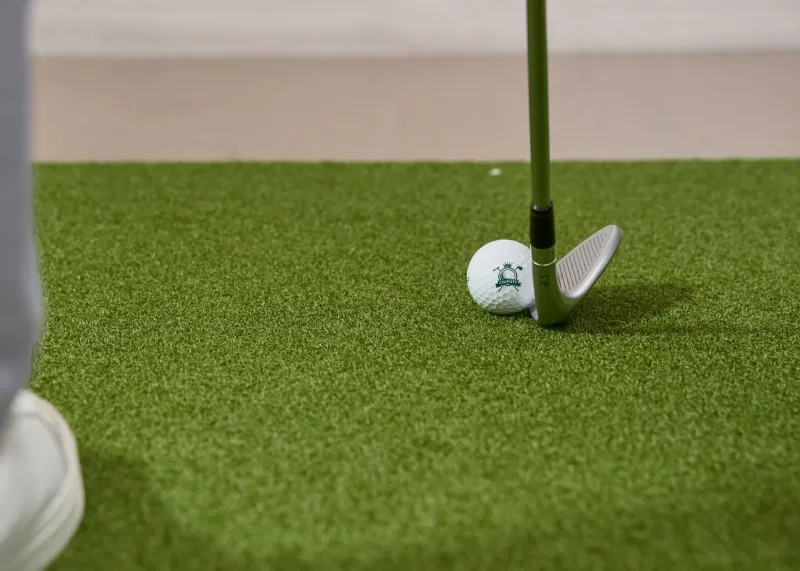
For most male amateurs, that window translates to a well-fit 8-iron or 9-iron. For many women and senior players, it's often a 7 or 8-iron. The specific club matters less than the honest yardage — which is why step one of the plan below is swallowing your pride at the launch monitor.
The Six-Week Ace Route Program
Here's the plan Coach Dan sketched on the back of a scorecard, refined over six weeks of my own testing.
Weeks 1–2: Find Your Truth. Hit 30 balls with every iron from 6 through wedge on a launch monitor. Ignore the best shot entirely. Find the club whose average carry lands in that 130–145 window with the tightest dispersion. That's your ace club. Write the number on a tee and put it in your bag zipper. Yes, really.
Weeks 3–4: The 50-Ball Ladder. Three range sessions a week, 50 balls each, all with the ace club. Targets at 130, 135, 140, and 145. No swinging for the fences — this is about dialing in a stock swing you could repeat at a wedding, a funeral, or the tee box at your local par 3 with your whole league watching.
Week 5: Pressure Cooking. Play nine holes using only the ace club off the tee on par 3s. Keep stats: greens hit, proximity to the hole, and — the metric that matters — how many finishes inside 15 feet. Aces are just tap-in birdies that got greedy.
Week 6: The Simulation. One ball, one hole, full pre-shot routine, every time. Coach Dan calls this "rehearsing the moment." Because the difference between a hole-in-one and a hole-in-oh-well isn't swing mechanics. It's whether your hands know what to do when the ball actually matters.
Glory Favors the Prepared
There's a reason this site is called Hole in One King and not Hole in One Lottery Winner. The ace is part luck, sure — but luck shows up more often for the golfer whose 140-yard iron keeps showing up on the dance floor. Master one club, own one window, and every par 3 in America becomes a chance at immortality.
The golf gods can't resist a prepared heart. Give them a repeatable 8-iron to work with.